Recognizing the Officers of the United States Foreign Service
◆
Embassies of the United States
An American embassy is the country's address abroad. Inside its walls, members of the Foreign Service issue passports and visas, assist Americans in trouble, report on events, negotiate, and represent the United States to the government and people of the host nation.
London, United Kingdom. The embassy at Nine Elms on the south bank of the Thames, which replaced the Grosvenor Square chancery in January 2018. Photo by Curran2, CC BY-SA 4.0, via Wikimedia Commons
Posts Around the World
The United States maintains embassies in the capitals of nearly every nation it recognizes, supported by consulates in major cities. Each is led by a Chief of Mission, usually an ambassador, and staffed by Foreign Service officers and specialists, civil servants, locally employed staff, and representatives of other federal agencies. Most are guarded by a detachment of United States Marines.
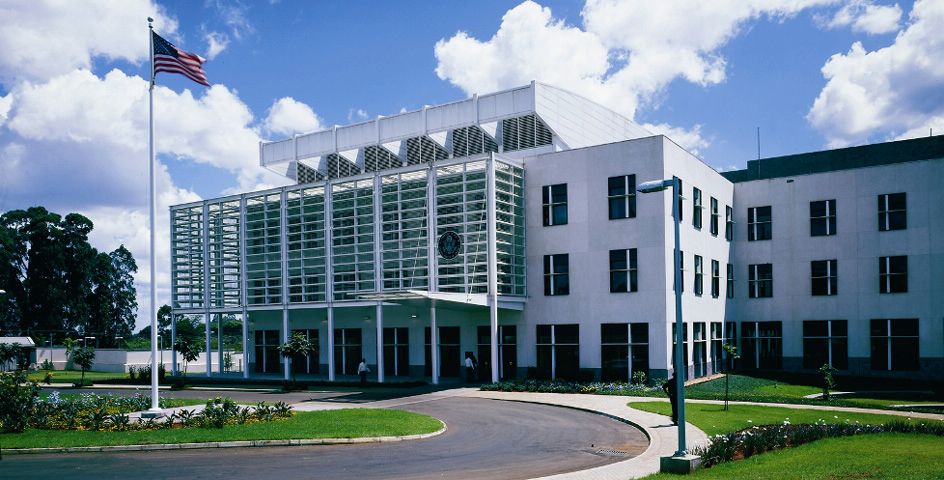
GermanyBerlinThe embassy on Pariser Platz, beside the Brandenburg Gate, on the site of the prewar American embassy. It opened on July 4, 2008.U.S. Embassy Berlin photo (public domain)FranceParisThe chancery on Avenue Gabriel, off the Place de la Concorde, lit in the colors of France.U.S. Embassy in France photo (public domain)ItalyRomePalazzo Margherita on the Via Veneto, once the residence of Queen Margherita of Italy, now the chancery of the U.S. Embassy.Photo by Harvey Barrison, CC BY-SA 2.0, via Wikimedia CommonsCanadaOttawaThe embassy on Sussex Drive, across from Parliament Hill, opened in 1999.Photo by Hayden Soloviev, CC BY 4.0, via Wikimedia CommonsBrazilBrasíliaThe embassy in Brasília's diplomatic sector, on the Avenida das Nações.Photo by Luis Dantas (public domain), via Wikimedia CommonsNorwayOsloThe embassy compound at Huseby, on Morgedalsveien in Oslo.Photo by Ahz, CC BY-SA 4.0, via Wikimedia CommonsJapanTokyoThe embassy in Tokyo's Akasaka district, a short walk from the Prime Minister's residence.Photo by Rs1421, CC BY-SA 3.0, via Wikimedia CommonsRepublic of KoreaSeoulThe embassy on Sejong-daero, facing Gwanghwamun Square in central Seoul, April 2024.Photo by Jjw, CC BY 4.0, via Wikimedia CommonsIndiaNew DelhiEdward Durell Stone's chancery in New Delhi, completed in 1959 and long counted among the finest American buildings abroad.U.S. Department of State, Bureau of Overseas Buildings Operations (public domain)KenyaNairobiThe embassy compound at Gigiri, built after the August 7, 1998 bombing of the former embassy in downtown Nairobi.U.S. Department of State photo (public domain)AustraliaCanberraThe embassy in Canberra's Yarralumla diplomatic quarter, built in the Georgian colonial style.Photo by T luxwolda, CC BY-SA 4.0, via Wikimedia CommonsIraqBaghdadThe embassy compound on the Tigris in Baghdad, at 104 acres the largest diplomatic compound in the world.U.S. Department of State photo (public domain)
Built to Represent, Built to Endure
The architecture of American embassies has carried a message of its own. In the decade after the Second World War, the State Department commissioned leading architects to design open, modern chanceries such as Edward Durell Stone's building in New Delhi. After the bombings of the embassies in Beirut in 1983 and in Nairobi and Dar es Salaam in 1998, security standards rose sharply, and many posts moved to new compounds set back from the street. The newest embassies, such as the one in London, try to answer both demands at once: open to the host city, and built to protect the people who work inside.
Behind every one of these buildings are the officers and specialists recognized on the Honor Roll, and the families who serve alongside them.